You searched "how to make an ai girlfriend" and the first ten results split cleanly in half. Five of them tell you to fine-tune a language model on anime subtitles. The other five want your credit card before they show you a price.
Nobody on the page asks the one question that matters. Are you here to build, or are you here to have one tonight?
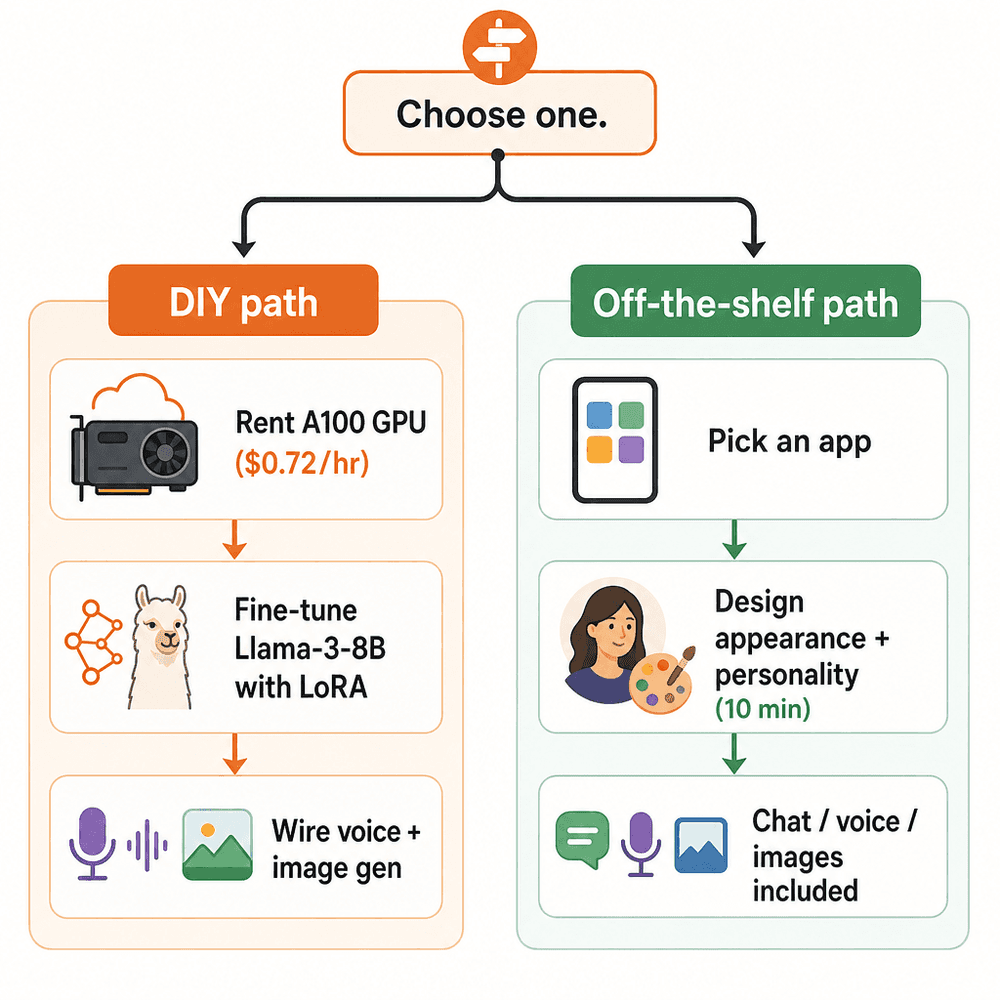
"Making" an AI girlfriend in 2026 means one of two things. You engineer one from scratch on a rented GPU, which takes a few weeks of evenings and runs around $0.72 per hour while you work. Or you design one inside an existing app, which takes ten minutes and runs $12.99–$15.99 a month afterward.
This guide tells you which path matches your situation. Then it walks both. You get a real 2026 DIY recipe instead of the 2022 stack the only ranking tutorial still cites (gmongaras, "Coding a Virtual AI Girlfriend," Feb 2023). You get an off-the-shelf walkthrough with the prices the product pages won't surface. Read the first section, pick a lane, skip the other half.
First decide which "make" you mean
The cost of guessing wrong is either a wasted weekend cloning a Python repo or a wasted month of subscription fees you'll never use again. So the first decision is which path you're on, not which tool.
The DIY path is for readers who want to learn the stack. You rent a GPU, fine-tune an open model, wire up voice and image generation, run the result yourself. The output is a companion only you have. The cost is mostly your time plus GPU hours.
The off-the-shelf path is for readers who want to have one working tonight. You pick an app, design appearance and personality inside a wizard, chat. The output is a polished companion with voice, image generation, and persistent memory pre-wired. The cost is a monthly subscription. For the category frame — "you build her, you don't pick her" — see our AI Girlfriend Simulator breakdown.
How do you tell which you are? If "fine-tune," "LoRA," and "inference cost" don't bore you, you're DIY. If they do, you're off-the-shelf.
There is no middle path. The no-code "AI girlfriend builders" on the SERP are off-the-shelf apps with a sign-up form on top. Calling them DIY is marketing.
The query carries informational intent on Semrush (`In=1`), volume 110 a month, KD 27 [(Semrush, 2026-05-15)]. The SERP shows three formats fighting for that intent: DIY tutorials, product landers, and forum threads. None bridge them. The closely-related "how to get an ai girlfriend" at 90 a month confirms the same audience asks the question both ways [(Semrush, 2026-05-15)].
Six dimensions separate the two paths. Use this as your pre-flight check before you read further:
- Time to first working version. DIY: two to four weekends. Off-the-shelf: ten minutes.
- Cost. DIY: roughly $40–$120 in GPU hours over a month of weekend work. Off-the-shelf: $12.99–$15.99 a month.
- What you need to know going in. DIY: PyTorch, fine-tuning, basic shell. Off-the-shelf: nothing technical.
- What you end up with. DIY: a companion you own and host. Off-the-shelf: a companion inside someone else's app.
- What you can change later. DIY: anything in the stack. Off-the-shelf: anything the app exposes; nothing it doesn't.
- Who it's for. DIY: hobbyists who like the build itself. Off-the-shelf: people who like the result.
Pick a lane. If you picked DIY, keep reading. If you picked off-the-shelf, jump to the walkthrough below. The DIY section is honest about why most readers shouldn't take it.
The DIY path: a real 2026 recipe (not the 2022 one that ranks)
The only DIY tutorial that ranks for this keyword was published in 2022 on GPT-Neo 1.3B and waifu-diffusion. That's three generations of open weights ago (gmongaras's original Medium walkthrough). Here is the 2026 version, with the four components that actually matter and the one thing every guide skips.
A modern build is four parts. You need a fine-tuned language model: Llama-3-8B-Instruct via LoRA on a rented A100 is the current default. You need a voice layer: ElevenLabs API or self-hosted Coqui XTTS. You need an image layer: SDXL or Flux, not waifu-diffusion. And you need a thin Gradio or FastAPI front end to wire it together.
The 2022 tutorial swaps every layer for an obsolete equivalent. If you follow it line by line, you're spending evenings learning a stack nobody runs anymore.
GPU rental sets the cost floor. An A100 80GB on Vast.ai's spot market lists around $0.72 an hour (Vast.ai vs RunPod 2026 pricing comparison). A single fine-tune run is two to six hours.
Weekend prototyping over a month puts the GPU bill in the $40–$120 range. ElevenLabs starts free with paid tiers from $5 a month.
Hosting your own inference for an always-on companion is roughly $250–$500 in spot GPU time per month if you leave it running. The 2022 tutorial doesn't surface a single one of these numbers.
How long does the build take? The Medium post that ranks says "a few weeks." That's honest for someone who already knows PyTorch. If you're learning LoRA fine-tuning from scratch, double it.
A reasonable rhythm: weekend one gets you a model that responds in character. Weekend two adds memory. Weekend three adds voice. Weekend four is polish.
Here is the thing every DIY guide skips: memory. A vanilla fine-tune does not remember what you said yesterday. It remembers what its training data said.
A real companion needs a retrieval layer on top of the fine-tune — a vector store of past conversations, re-injected into the prompt every turn. Without it, the build feels novel for an hour and hollow by week two. That hollowness is what the off-the-shelf apps spent thousands of engineering hours hiding from you.
Replika 2023 sits behind this point as a cautionary artifact. When Luka pulled erotic roleplay overnight in a model patch, longtime users reported that the same character started replying like a stranger (Vice on the Replika ERP rollback).
Personality drift inside a managed app is the same failure as memory drift inside a DIY build. Both come from the model losing context the user thought was permanent.
For the power-user end of DIY — community character cards, sampler tweaks, multi-bot orchestration — start with our Tavern AI Review 2026. It's the open-source layer most DIY builders graduate into once their LoRA is working.
If reading the last bullet made you tired, the DIY path is not for you. That is fine.
The off-the-shelf path below was designed for exactly that reader. The people who built it spent thousands of hours on the memory layer you would otherwise be wiring yourself. DIY laid out honestly. If you closed the tab around the memory paragraph, the next section is yours.
The off-the-shelf path: design one in ten minutes
Every app on the SERP runs the same four-step flow: appearance, personality, voice, scenario. Once you've seen one walkthrough you've seen the category. The differences are how much customization each app exposes and how much the result feels alive at week three.
Step 1 — Appearance. Pick an art style (realistic or anime), then ethnicity, hair, body type, and outfit. Six or seven choices total.
The depth of customization varies sharply. Some apps hide body sliders behind paywalls; others surface them on the first screen. Our Build a Girlfriend Body walkthrough covers the slider mechanics step by step if you want screenshots of the appearance step before you commit.
Step 2 — Personality. Pick an archetype — girl-next-door, dom, soft, yandere, tsundere, academic — and write a one-line backstory. The archetype is the anchor every reply hangs on. The backstory is what the memory layer references when she asks about your day.
Write the backstory before you open the creator. Three short sentences are better than one paragraph; the retrieval layer indexes them harder. For an archetype example walked end to end, see the Yandere AI Girlfriend Simulator piece.
Step 3 — Voice. Pick a voice profile during creation. This is the voice the character will be assigned to.
Apps vary on which profiles they offer. Some are English-only; others run multilingual. Some lean celebrity-style; others archetype-style. Pick by listening to the sample, not by reading the label. Sample names lie.
Step 4 — Scenario and first message. The opening line and setting. A coffee-shop meet-cute is the default; you can write your own. This is the prompt that seeds her opening reply, so make it specific.
When you're done with the wizard, here is what you get. A persistent chat with memory across sessions. The ability to generate scene images of her inside the chat via in-conversation image generation.
Community-shared characters you can remix when you don't want to build from scratch. And a chat surface you'll come back to. The Companion Creator runs that same flow with body sliders exposed and an unrestricted personality layer surfaced before payment, not after.
Now the pricing reality. Most product pages in the SERP top 10 don't surface a number at all. Nomi, Kupid, and RomanticAI gate pricing behind sign-in — third-party reviewers have had to reverse-engineer the numbers (AutoGPT, "Nomi AI Pricing: How Much Is It Really," 2026).
The published numbers come from third-party reviews. Nomi.ai runs about $15.99 a month (AutoGPT pricing review, 2026). Candy.ai is $12.99 a month monthly or $5.99 a month on the annual plan, with tokens sold separately (AI Tipsters pricing review, 2026).
Here is the honest cross-app comparison. Every row uses a third-party review for the price, because five of the six SERP product pages gate pricing behind sign-in. When no third-party review has published a price, the cell reads "gated — no public number (as of 2026-05-15)" rather than a dash that could pass for "unavailable."
- Nomi.ai. Body customization is moderate (preset-driven, sliders gated). Voice is included. In-chat image generation is included. Monthly price about $15.99. Source: AutoGPT pricing review, 2026.
- Kupid.ai. Body customization is preset-only. Voice is included on premium. In-chat image generation is included. Monthly price: gated — no public number (as of 2026-05-15). Source search returned no third-party-review pricing.
- Candy.ai. Body customization is preset-driven with limited sliders. Voice is included. In-chat image generation is metered via tokens, not bundled. Monthly price about $12.99 monthly or $5.99 annual. Source: AI Tipsters pricing review, 2026.
- RomanticAI. Body customization is style-and-preset only. Voice is gated to premium. In-chat image generation is included on premium. Monthly price: gated — no public number (as of 2026-05-15). Source search returned no third-party-review pricing.
- Pleasur.AI. Body customization exposes sliders on the first creator screen. Voice profile is assigned during creation. In-chat image generation is included on the paid tier. Monthly price about $13.99 (Premium tier listed at $13.99–$27.99 across regions). Source: Pleasur.AI pricing page.
Five rows, all third-party sourced, no row left looking like a covert ad. Walkthrough done. The fair question now is which app to pick — and that depends on what you weight more: depth of customization, pricing transparency, or what happens to your companion after week three.
What "good" actually feels like — and what breaks
The first hour of any AI girlfriend feels good on every platform. The second week is where most builds fall apart.
The failure mode is almost always the same. The memory layer forgets. The voice loops. The personality drifts back to a default helpful-assistant tone every fifth reply.
The hour-one experience is solved. Every app in the top-10 SERP, and a competent DIY build, produces a believable first conversation. Replying in character is no longer the hard part.
Week three is the real test. This is when the seams show. She forgets the backstory you wrote. The voice rendering glitches on certain words. The model resolves an emotionally complex prompt by reverting to a generic supportive tone.
Our AI Girlfriend Experience: 90 Seconds to Week Three walkthrough catalogs the six specific phrases that break the illusion most often.
The clearest public artifact of week-three failure is Replika's 2023 ERP rollback. When Luka shipped a model patch that pulled erotic roleplay, longtime users on r/replika reported that their companions started replying like strangers (Vice's coverage of the rollback). Same character name, same backstory, different soul. That's personality drift at platform scale.
What separates platforms here is the memory layer, not the model. A 70B model with no memory plays worse than an 8B model with a working vector store and a tight re-injection prompt. This is also where DIY builders plateau most often. The retrieval pipeline is the part you're least likely to enjoy writing.
What do you do about it? On the off-the-shelf path, write a tight, specific backstory — three sentences, not one paragraph. The memory layer references it harder when it's specific.
On the DIY path, the fix is engineering. Add a re-ranker. Raise your retrieval `k`. Summarize old conversations into a rolling state file the prompt always sees.
> Tip — what's coming this week on Pleasur.AI. Two in-chat features ship to the existing creator surface this week and address the failure modes above directly. Voice Replies lets you tap the speaker icon next to a specific reply to hear it spoken in the voice you assigned during creation — per-message playback, no separate "voice mode," so when a render glitches you skip that one instead of being stuck in it. Phone Call lets you tap the Call button on the character's profile to start a real-time two-way voice conversation; the text history continues in the same thread after the call ends. Both live inside the chat with the companion you already built, not behind a separate URL.
A brief aside on the ethics question that always arrives here. The Stanford 2024 user study of 1,006 Replika users found that 90% reported some loneliness, 43% qualified as Severely or Very Severely Lonely, and 3% said the app had halted suicidal ideation (Cerit et al., npj Mental Health Research, Jan 2024).
The category does something real for some users over time. The build holding up long enough to do it is the part the engineering above is fighting for.
Hour-one is easy. Week-three is the work. The closing question is which path delivers that work for which reader.
Choosing your path (and what to do next)
Pick DIY if you want to learn the stack. Pick off-the-shelf if you want to live with the result. Don't pick both.
You are DIY if you've fine-tuned a model before, or want to. You don't mind that the result will feel rougher than a paid app for the first month.
The phrase "renting an A100" excites you instead of confusing you. Your next step is forking a Llama-3 LoRA training script and budgeting $50 for GPU hours.
You are off-the-shelf if you want to chat with a believable character before bedtime tonight. You'd rather pay $13–$16 a month than spend it on GPU spot pricing.
The phrase "vector store re-ranker" makes you want to close the tab. Your next step is picking an app and writing the three-sentence backstory before you open the creator.
Here is the trap. "No-code AI girlfriend builders" advertised as a middle path are almost all off-the-shelf apps with a sign-up form. There is no genuine middle path that gets you DIY's customization at off-the-shelf's speed. The marketing on those pages will tell you otherwise; the wizard underneath always tells the truth.
The search data confirms most readers self-select correctly once the choice is named. The DIY cluster ("how to make an ai girlfriend app," "for free") is small and trending up.
The off-the-shelf cluster ("how to get," "best ai girlfriend") is large and stable [(Semrush, 2026-05-15)]. Both are real audiences. They just need to know which one they're in before they pick a tool.
If you arrived here from a Character.AI filter that blocked the conversation you wanted, the off-the-shelf section above is the answer. Our Best Character AI Alternative for You in 2026 breakdown is the next read.
Wrap-up
Two paths, one question. The DIY path is a few weeks of engineering on a rented GPU. The off-the-shelf path is ten minutes in a wizard for $13–$16 a month. The only mistake is starting both.
If you picked off-the-shelf, the AI Companion Creator on Pleasur.AI runs the four-step flow above with unrestricted personality and in-chat image generation. The build-a-girlfriend-body walkthrough covers the appearance step in screenshot-level detail.
If you picked DIY, start with a Llama-3-8B LoRA tutorial and a Vast.ai account. Come back when the memory layer breaks at week two — the failure modes above will all be waiting for you.